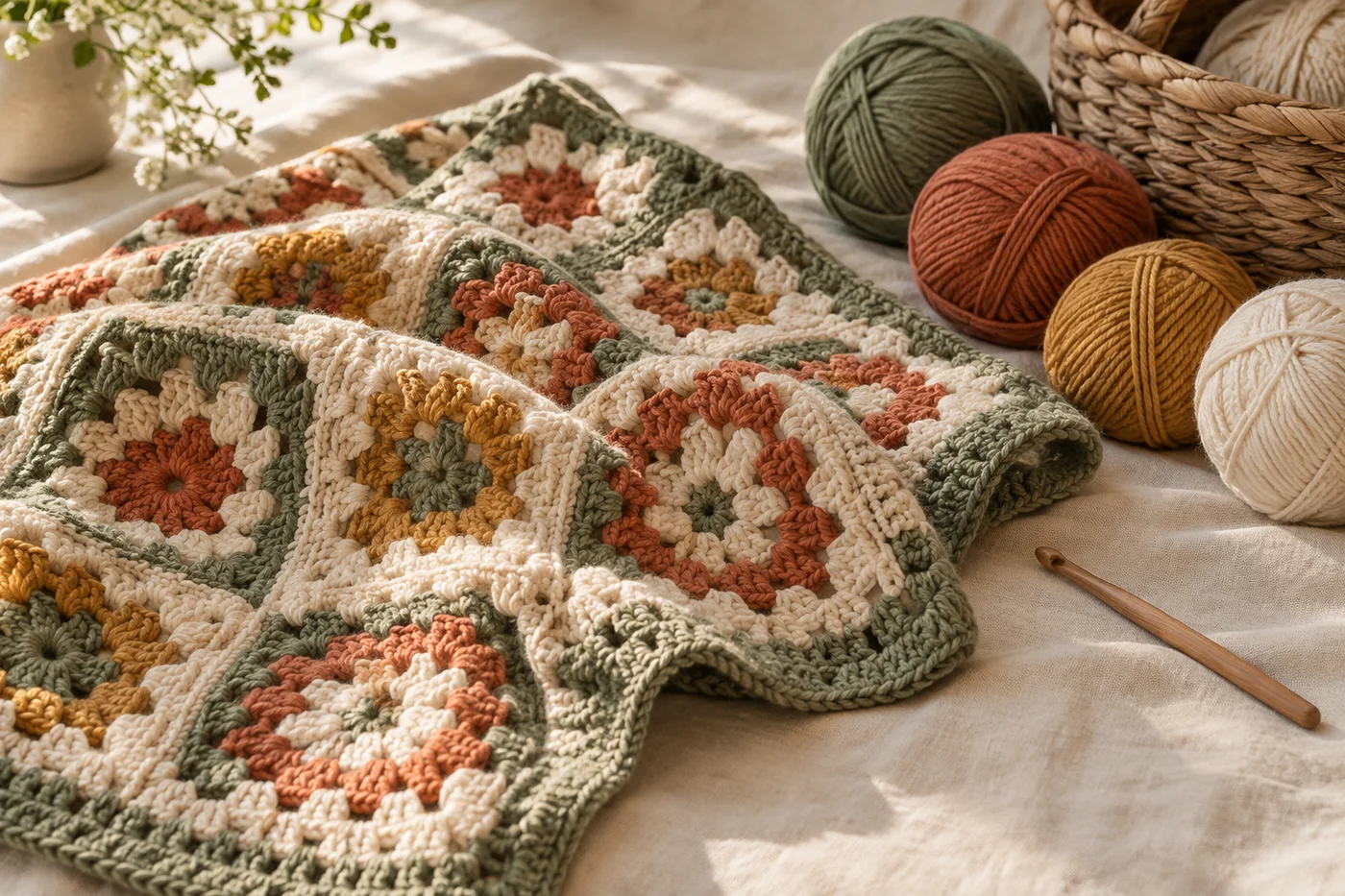
A little yarn, a lot of possibility
Crochet is a way to make fabric by drawing loops of yarn through other loops with a hooked tool. You build the fabric one stitch at a time. A few repeated movements can become a coaster, scarf, blanket, bag, or decorative square. You do not need to learn every stitch before making something useful.
For your first session, aim to understand the tools and make a short practice chain. That is a meaningful beginning. Your early stitches may look uneven because both hands are learning new jobs. A small practice piece lets you experiment without the pressure of finishing a large project.
How the fabric grows
In ordinary crochet, you usually keep one active loop on the hook between completed stitches. You insert the hook where the instructions tell you, catch the working yarn, and pull it through. The working yarn is the strand leading to the ball. The short loose end is called the tail.
A foundation chain gives many flat projects their starting edge. After the first row, you turn the work and make another row into the stitches you have just completed. Projects worked in rounds grow around a center instead. Special methods, such as Tunisian crochet, work differently; they can wait until you are comfortable with the basics.
Look closely at a finished row. Most basic stitches have a little V at the top. Recognizing those Vs helps you find the next place to insert your hook and count the stitches you have made.
Crochet and knitting
Crochet generally uses one hook, while knitting commonly uses two needles with multiple live stitches. Both can make soft fabric, and neither is a required first step for the other. You can start crochet without any knitting experience.
If you make a mistake in a simple crochet practice piece, remove the hook and gently pull the working yarn to undo stitches. Stop at the last correct stitch and put the remaining loop back on your hook. Undoing work is a normal part of learning, not evidence that you are failing.
Know which stitch language you are reading
Crochet Academy uses US crochet terminology. Some UK stitch names describe different stitches, so check the terminology statement before following any pattern. These common equivalents are checked against the Craft Yarn Council abbreviation guide.
| US name | UK equivalent |
|---|---|
| Single crochet (sc) | Double crochet (dc) |
| Half double crochet (hdc) | Half treble (htr) |
| Double crochet (dc) | Treble (tr) |
| Treble crochet (tr) | Double treble (dtr) |
You do not have to memorize this table today. Keep the downloadable stitch reference nearby and use one terminology system throughout each project.
Your first learning path
- Choose a smooth, light-colored yarn and a hook that suits its label.
- Practice holding the hook and feeding yarn through your other hand.
- Make an adjustable slip knot and place its loop on the hook.
- Learn to make a chain before attempting a row of stitches.
- Learn US single crochet and count every row.
- Use a small rectangle to practice turning and finishing.
A bookmark or simple coaster gives you repeated practice with the same stitch. Choose your project after learning the chain and single crochet. A complicated shape can introduce several unfamiliar skills at once, making it harder to identify the part that needs practice.
Try this before the next lesson
Find one crocheted object or look at the decorative project photographs on this site. Notice its texture, repeated shapes, and edges. Then write down one small thing you would like to make. This gives your practice a purpose without setting a deadline.
Do I need a full kit? No. One suitable hook, one ball of yarn, scissors, and a yarn needle cover the essentials. Can I learn left-handed? Yes. Use your left hand for the hook if that feels natural; the yarn hand and working direction will mirror right-handed demonstrations.
Continue to Crochet Supplies for Beginners to build a short shopping list. The complete beginner course lists the skills ahead and clearly marks lessons that are still coming soon.